
Growing businesses are under steady pressure to modernize: new dashboards, more automation, AI tools, ERP upgrades. Each one promises faster answers, and each one depends on inventory number accuracy.
But before deciding what to add next, it is worth looking at the process behind the number.
Every tool depends on that number. When the inventory number is unclear, everything built on top of it inherits the confusion. Understanding how that number is created, changed, and trusted has become the first decision, not an afterthought.
A Familiar Moment
The inventory report shows one number. The sales team is working from another. Operations knows about exceptions that haven't been entered yet. Accounting is waiting on a final count to close the month.
Then leadership looks at the report and asks, "Which number is right?"
So the business fixes the number. Someone recounts, checks the spreadsheet, and updates the system, and then there is another meeting.
That work is often necessary. But it answers only today's question. It leaves the more important one open:
How did we end up with more than one version of the same number?
Figure 1
An inventory number passes through six hands before anyone trusts it.
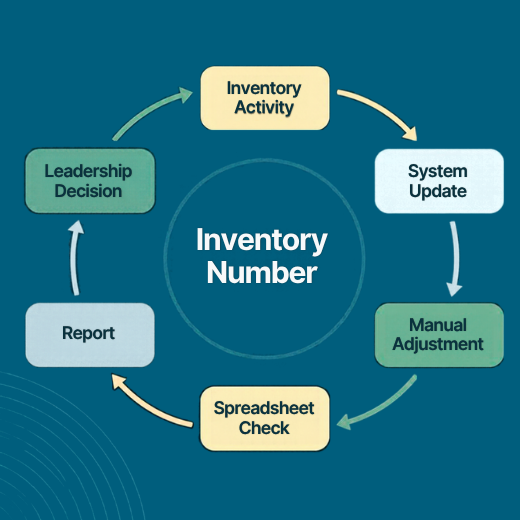
As Figure 1 shows, a number can start with a purchase order, a receipt, a sales order, a return, a damaged item, a hold, or a manual adjustment. From there it moves through people, systems, and spreadsheets before it reaches a decision.
When that path is visible, you can see where a number came from and why it changed. When it isn't, the number becomes something you have to defend rather than something you can use.
Many growing businesses keep correcting the final number without examining how it got there. But the answers are in that movement:
- Who touched the number, and when?
- Was the item received but not entered?
- Was it committed to a customer but still showing as available?
- Was it damaged, returned, on hold, or counted twice?
- Was the spreadsheet updated while the system was left behind?
These aren't data questions. They're operating questions. As the business grows, they become leadership questions.
Why Inventory Number Accuracy Matters More Now
Businesses are making more decisions from data than ever: what to order, hold, restock, discount, and promise customers. Many are also preparing for dashboards, automation, AI tools, or ERP upgrades.
None of those can create clarity on their own.
A dashboard shows the number faster.
Automation moves the number faster.
AI summarizes the number faster.
Speed doesn't resolve confusion. If the number is unreliable, faster reporting only helps the business make unclear decisions sooner.
Questions to Ask Before the Next Tool
- Where does this number start?
- Who updates it, and when?
- Which exceptions are handled outside the system?
- Which spreadsheet exists because the system isn't trusted?
- Where do sales, operations, warehouse, and accounting define the number differently?
- What has to be corrected by hand before leadership trusts the report?
These questions don't slow the business down. They reveal what's already happening.
Once the path is visible, the right next step usually becomes clear. Maybe the process needs to be documented, or ownership needs to be defined. Maybe the timing of updates needs to change. Maybe a spreadsheet should be connected or retired. Maybe the current system is capable and only the setup around it needs attention. Or maybe a new system really is needed.
But that decision belongs after you understand the path, not before.
Clarity Starts Upstream
The businesses that operate with the most clarity won't be the ones that adopt every new tool first. They'll be the ones that understand how their work actually moves.
Reliable inventory insight does not begin at the dashboard. It begins upstream, in the process behind the number.
See It Clearly
If your inventory numbers don't match, the first question may not be "What software do we need?" It may be "What path did this number travel before we trusted it?"
That's what we look at in a Data Clarity Review: a complimentary 30-minute conversation, followed by a written diagnosis within 48 hours. No obligation. Your team may be working from conflicting counts or disconnected reports. A spreadsheet may have quietly become the source of truth. The review shows where the breakdown is happening and what to clarify first, before you invest in another fix.
Learn about the Data Clarity Review
Mapp Technology helps growing businesses identify where inventory numbers, reports, and workflows stop lining up, so leaders can make decisions based on reality, not guesswork.